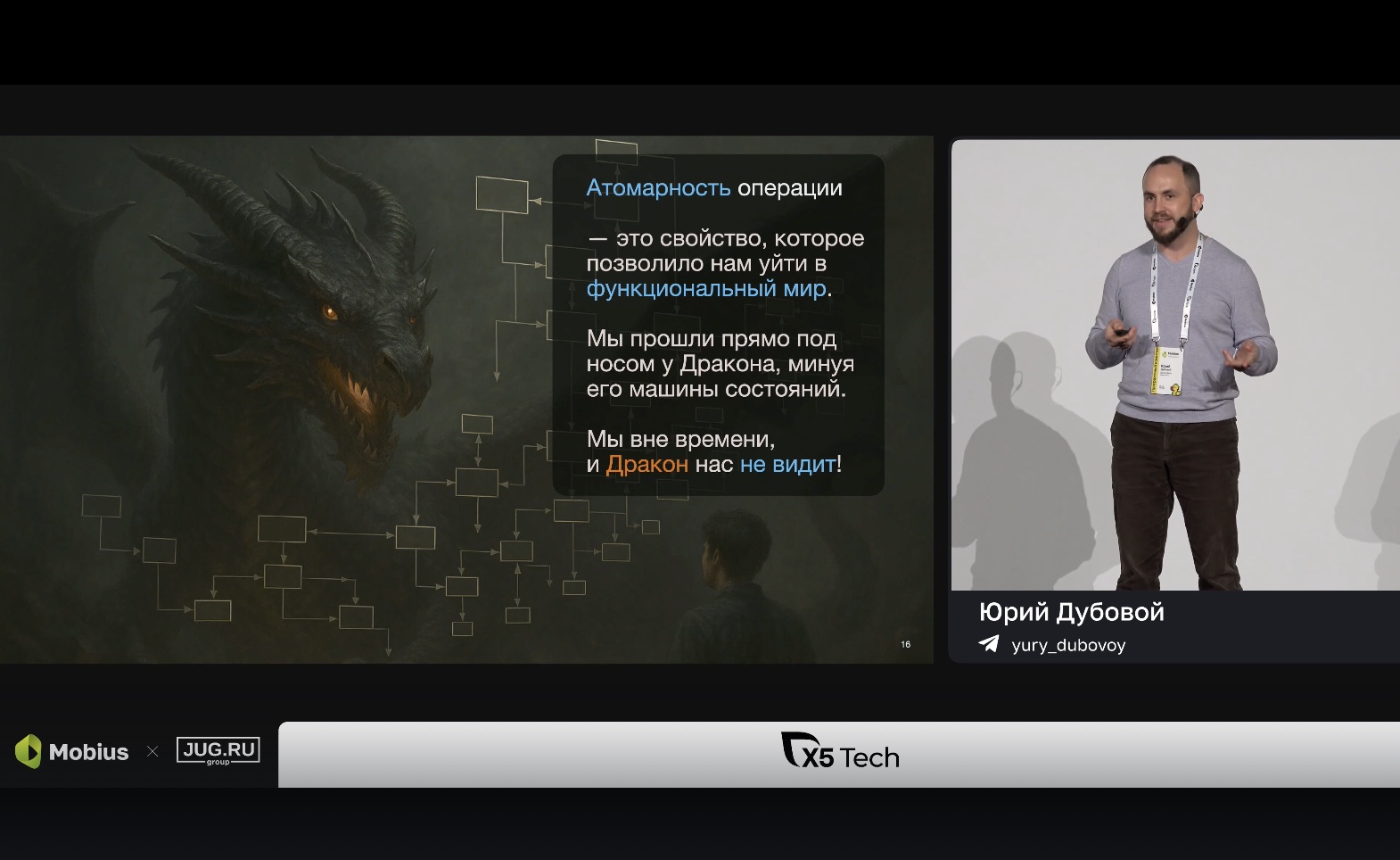
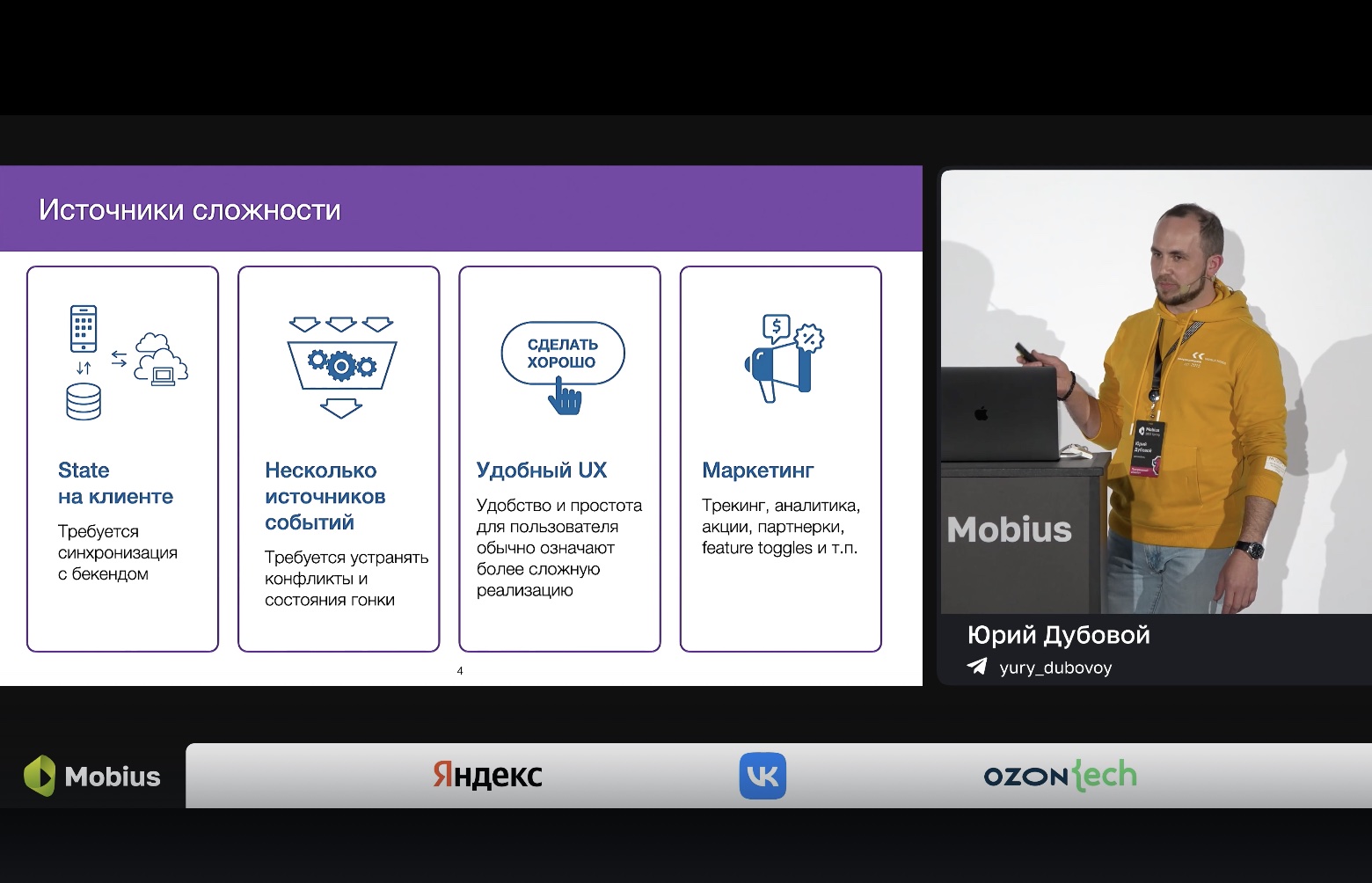
The Dragon of Complexity lives inside state machines. The Dragon is neither evil nor kind; it is part of the world’s nature, and fighting it is pointless. The weak are devoured by complexity, and the strong, should they win, turn into Dragons themselves. This happens over and over again: OOP, FP, DDD—any approach or framework created to fight complexity eventually grows a complexity of its own that is no smaller than the original.
Wave architecture in practice. Mobius 2025 Autumn
We instinctively try to domesticate and shrink the Dragon through the law of large numbers, intentionally simplifying the domain model and the model of user behavior by leaning on statistics. This bleaches out the variety of features, behavioral scenarios, and interfaces. Only what is mathematically optimal survives in our services, meaning average, sterile solutions. As a result, we find ourselves in a world of monstrous super-apps that look surprisingly similar to each other, even though just 10–15 years ago mobile development was a boiling cauldron of diversity.
Uniformity and sameness hide danger. When a Black Swan crashes into such a degenerate ecosystem, it perishes entirely because it contains too few species and, under the new conditions, there is simply nobody left who can evolve.
Today we can fix this. The Wave model can change the way we work and give us a solid foundation for service personalization. We will not fight the Dragon of Complexity and we will not try to tame it—we will bypass the Dragon along a wave bridge.